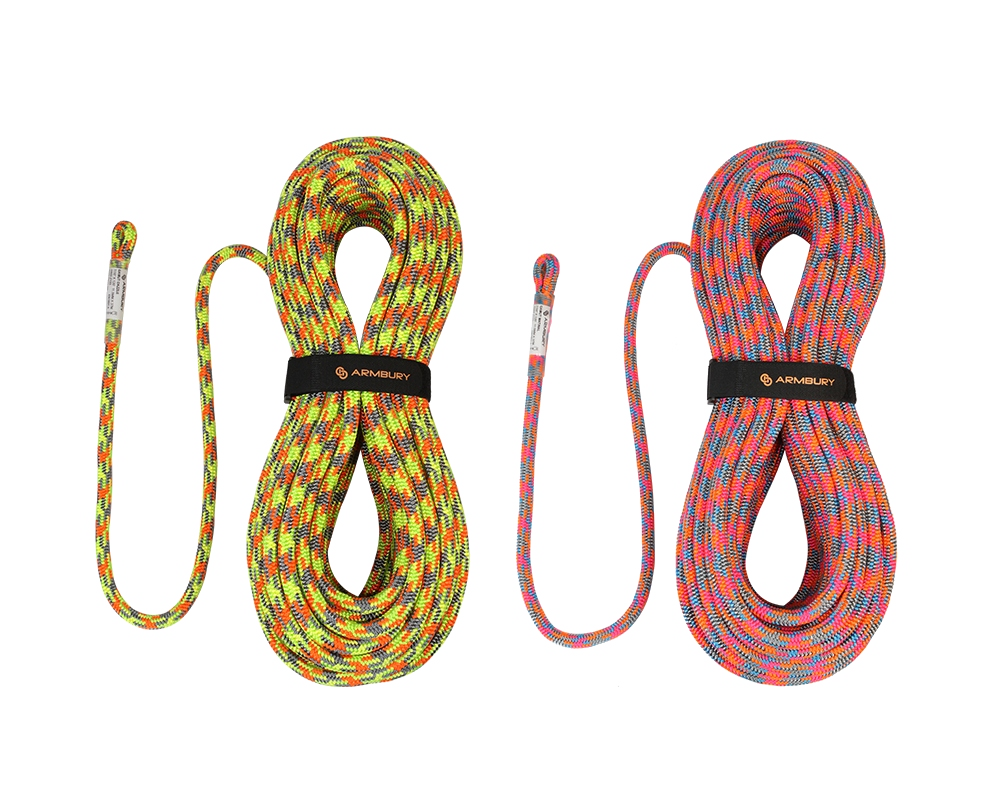
Purpose-built tree climbing ropes engineered for professional arborists who trust their lives to every meter of rope. From SRT ascent to large-wood rigging, ARMBURY delivers certified performance.
Professional tree care demands rope that can endure sustained friction from friction hitches, repeated loading and unloading cycles through rigging hardware, and exposure to wood resin, hydraulic fluid, and chainsaw exhaust — all in a single workday. ARMBURY's arborist range is engineered with these realities at the center of the design brief, not as afterthoughts.
Every ARMBURY arborist climbing rope is independently certified to ANSI Z133 — the American National Standard for Arboricultural Operations — which specifies minimum breaking strength, construction requirements, and marking standards for ropes used in professional tree work. ARMBURY is also an active member of the Tree Care Industry Association (TCIA).
SRT climbing demands a rope with minimal elongation so that each movement on the ascender or mechanical device translates directly into upward progress. ARMBURY SRT-optimized climbing lines use a 16-strand or 12-strand braid construction with a tight, firm sheath that resists glazing from repeated friction-hitch engagement and delivers consistent hand-over-hand feel during the working day.
The doubled redirect system places two rope strands through the redirect, halving the apparent load on the climber at the cost of doubling the rope weight in the canopy. ARMBURY DdRT climbing lines are optimized for smooth running through redirect pulleys, with a sheath-to-core ratio that maintains flexibility over long shifts. The consistent diameter across the rope's full length ensures predictable friction-hitch performance.
Rigging ropes experience dynamic shock loads that are fundamentally different from static climbing loads. ARMBURY rigging lines are constructed from high-tenacity polyester with a high energy-absorption factor and rated for repeated drop-and-catch cycles. Available in 12mm and 14mm diameters for compatibility with standard rigging rings and blocks.
High-productivity speedlining requires rope that runs freely through a lowering device and recovers its round cross-section after passing through pinch points. ARMBURY's arborist rigging ropes are tested under cyclic loading through friction plates and rated for the equivalent of 500+ lowering cycles without measurable sheath wear.
Ground crews use ARMBURY arborist lines as tag lines, pull lines, and anchor extensions. The same chemical resistance and abrasion performance that arborists trust aloft transfers directly to ground-level rope handling across varied terrain.
10.5–11mm for SRT efficiency; 12–13mm for DdRT and maximum knot-tying performance with friction hitches.
Lower elongation (<5% at 100kg) for SRT ascent systems. Higher elongation acceptable for DdRT where working comfort takes precedence.
Tightly braided sheaths resist cuts and abrasion from bark and hardware edges. A sheath percentage above 40% of total rope weight indicates durability-focused construction.
All ARMBURY arborist ropes are tested for resistance to chainsaw bar oil, gasoline, common herbicides, and wood resin to ensure service-life integrity.
Need help selecting the right climbing line for your system? Our team works directly with professional arborists — reach out for a recommendation.
Contact Us →Most arborists use 11–13mm ropes for standard DdRT climbing. For SRT, a 10–11mm rope with low elongation is preferred to maximize efficiency during ascent. ARMBURY arborist ropes are available from 10.5mm to 13mm to cover both applications.
Yes. All ARMBURY climbing ropes sold for arborist applications meet or exceed ANSI Z133 minimum breaking strength requirements. Each rope ships with a certificate of conformity and batch test documentation on request.
SRT runs a single strand from a fixed anchor at the top of the tree to a mechanical ascender on the climber's saddle. DdRT runs the rope over a redirect at height and back to the climber, giving a mechanical advantage but doubling the load on the anchor point. ARMBURY's range includes options optimized for each method.
ANSI Z133 requires visual and tactile inspection before each use. The rope must be retired immediately if it shows cuts, sheath glazing, core damage, severe kinking, or has been subjected to a shock load. Most professional arborists retire climbing lines after 2–4 years of regular daily use regardless of visible condition.
ARMBURY's arborist line includes both climbing ropes and dedicated rigging ropes (TRITON, TETHYS) designed for the higher shock-load demands of section lowering and speedlining. Climbing lines should not be used as primary rigging ropes.